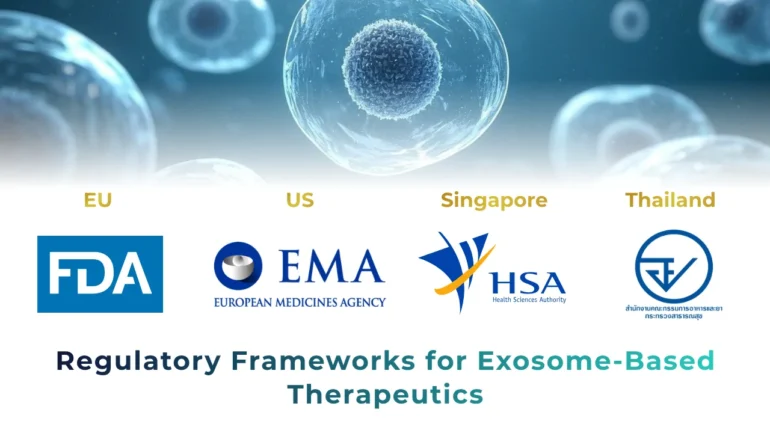
Exosomes, those tiny extracellular vesicles secreted by cells, have captured the imagination of biotech innovators worldwide. Packed with proteins, lipids, RNAs, and other bioactive molecules, they hold immense promise for targeted drug delivery, regenerative medicine, and treating conditions ranging from neurological disorders to cancer. For biotech startups, the path to commercializing exosome products is exhilarating—but fraught with regulatory hurdles.
As of October 2025, no exosome-based therapeutic has received FDA approval, underscoring the need for meticulous compliance.
How are Exosome Therapeutics Regulated by FDA and EMA?
1. U.S. FDA Regulatory Framework
Classification
Exosome products for therapeutic use are regulated as drugs under the Federal Food, Drug, and Cosmetic Act (FD&C Act) and biological products under Section 351 of the Public Health Service (PHS) Act.
Fall within regenerative medicine, particularly for allogeneic applications (e.g., exosomes from mesenchymal stem cells or amniotic fluid).
Minimal manipulation (defined in 21 CFR 1271.3(f)) refers to processing that does not alter the relevant biological characteristics of cells or tissues (e.g., basic isolation without engineering).
Most therapeutic exosomes (e.g., engineered with RNA/protein cargo or used for non-homologous functions) are not minimally manipulated and are regulated as drugs/biological products under Section 351, requiring IND/BLA.
Only minimally manipulated HCT/Ps intended for homologous use and meeting other criteria (e.g., no systemic effect) may be regulated under Section 361 of the PHS Act, which is less stringent and can be commercialized without undergoing drug approval process required for “351” products.
Premarket Requirements For Non-Minimally Manipulated Products
Although the FDA has not yet issued a dedicated “Exosome Therapeutic Product Guideline,” manufacturers must adhere to biologics pathways and comply with Chemistry, Manufacturing, and Controls (CMC) and Good Manufacturing Practice (GMP) requirements applicable to biologics.
Require an Investigational New Drug (IND) application for clinical trials, including detailed safety and efficacy data.
Need a Biologics License Application (BLA) for market authorization, ensuring rigorous quality, safety, and efficacy evaluation.
Regulatory Oversight:
Currently, no specific regulatory guidelines exist for exosome therapies. However, existing standards for cell and tissue-based products can provide useful guidance for characterizing exosome-based therapeutics during nonclinical and clinical development.
Governed by FDA guidance on Chemistry, Manufacturing, and Controls (CMC) requirements applicable to biologics.
2. EU EMA Regulatory Framework
Classification
Exosome-based therapeutics may be classified as Advanced Therapy Medicinal Products (ATMPs) under Regulation (EC) No 1394/2007 if they meet specific criteria:
Contain functionally active cargo (e.g., mRNA, miRNA, or proteins) with a defined therapeutic mechanism of action (e.g., gene silencing, tissue repair).
Undergo substantial manipulation (e.g., genetic modification, loading with therapeutic agents, or extensive purification) or are used for non-homologous functions (i.e., functions different from their natural role).
May be categorized as gene therapy medicinal products, somatic cell therapy medicinal products, or combined ATMPs (e.g., exosomes integrated with a medical device).
Exosomes that are not substantially manipulated and used for homologous functions (e.g., minimally processed for natural immune modulation) may not qualify as ATMPs and could be regulated under Directive 2001/83/EC or other national frameworks.
Approval Process
ATMP-classified exosomes require a centralized marketing authorization procedure through the European Medicines Agency (EMA), involving preclinical and clinical data to demonstrate safety, efficacy, and quality.
The Committee for Advanced Therapies (CAT) assesses ATMP classification, with manufacturers able to request a formal classification procedure for clarity.
Classification is case-specific, depending on the extent of manipulation and intended use.
For both US FDA and EMA requirement, product manufactureurs must ensure compliance with Good Manufacturing Practice (GMP) and address challenges like batch-to-batch variability and immunogenicity.
International harmonization of regulatory frameworks, particularly between the FDA and EMA, plays a crucial role in streamlining the global commercialization of exosome-based therapeutics.
Many ASEAN countries align with FDA and EMA guidelines to meet global benchmarks, though specific requirements vary across member states. Compliance with the FDA’s stringent Section 351 standards and the EMA’s ATMP framework enhances market access worldwide.
3. Singapore Health Sciences Authority (HSA)
HSA does not explicitly list exosomes in its CTGTP framework. However, exosome-based therapeutics are likely regulated as Cell, Tissue or Gene Therapy Products (CTGTP) when they are substantially manipulated, used for non-homologous functions, engineered with therapeutic cargo, or administered allogeneically.
Conversely, minimally manipulated exosomes used autologously for homologous functions may fall outside CTGTP regulation, subject to HSA’s product classification assessment.
Early engagement with HSA is recommended to confirm classification.
CTGTP requirements include:
Product classification based on manipulation and intended use (analogous to FDA 351 / EMA ATMP rationale)
IND-equivalent submissions for clinical trials under Clinical Trial Authorisation (CTA)
GMP compliance aligned with PIC/S standards for biologics manufacturing
4. Thai FDA (TFDA)
Under the Thai FDA’s regulatory framework, exosome-based therapeutics would reasonably be treated as biological medicinal products (or advanced therapy products) under the Drug Act B.E. 2510, subject to GMP, clinical trial authorisation and quality oversight as with cell- and gene-based therapies.
However, there is no publicly available Thai FDA guideline that explicitly classifies exosomes.
Product-specific classification discussions with Thai FDA are strongly advised.
Scientists aiming to commercialize exosome products should engage early with the regulatory bodies to clarify product classification, ensuring efficient navigation of clinical trials and market authorization processes across regions while meeting rigorous safety, quality, and efficacy standards.
How Startups can build a GMP-Compliant Exosome Pipeline
Commercialization begins with regulatory strategy. Here’s a phased approach tailored for startups:
Pre-IND Preparation: Conduct thorough preclinical studies to establish safety and mechanism of action. Engage in FDA’s INTERACT or pre-IND meetings for early feedback on your CMC plan. Focus on standardization: Use validated assays for exosome isolation, purity (e.g., >95% exosome content), and characterization (size, markers like CD63/CD81).
IND Submission: File an IND to initiate clinical trials. Include detailed manufacturing protocols, quality controls, and risk assessments. GMP compliance is non-negotiable here. Partner with contract manufacturing organizations (CMOs) if in-house capabilities are limited.
Clinical Development: Adhere to Good Clinical Practices (GCP) for trial design, emphasizing patient safety and data integrity. Monitor for adverse events via MedWatch and adjust based on interim results.
BLA Pathway: For market approval, submit a BLA with robust data demonstrating safety and efficacy. Post-approval, maintain pharmacovigilance and labelling compliance.
IND Module 3: Chemistry, Manufacturing, and Controls (CMC) for Exosome Therapeutics
Exosome products must adhere to comprehensive CMC standards outlined in FDA guidances for biologics and gene therapies, which apply analogously to extracellular vesicles (EVs). This includes detailed documentation in IND submissions (Module 3) covering drug substance (DS) and drug product (DP) manufacturing, analytical methods, and stability data.
Key elements involve validating manufacturing processes for raw material control, exosome preparation, separation, concentration, and characterization to ensure consistency, purity, and potency, ensuring reproducibility and scalability from lab to GMP levels.
Risk-based approaches are essential to address EV heterogeneity, with validation confirming cargo encapsulation efficiency and surface modifications using advanced analytics like single-vesicle profiling.
When developing EV or exosome-based therapeutic products, attention to impurities (both those intrinsic to the exosomes and those extraneous to them) is critical for safety, immunogenicity, and regulatory acceptability. Startups should prioritize GMP compliance early, including controls to prevent contamination and assessments of adventitious agents in animal-derived materials.
Two primary safety concerns are recognized for EV-based therapeutics:
(1) the safety of the EVs themselves, and
(2) risks from co-isolated impurities and contaminants.
Although EVs can confer therapeutic benefit, they are also involved in disease biology. For example, tumor-derived EVs can promote cancer progression and may trigger unintended adverse effects if not fully removed. Therefore, careful control of source cells and EV heterogeneity is required during development and manufacturing.
The second category of risk arises from adventitious agents and process-derived impurities, including mycoplasma, viruses, endotoxins, medium supplements (e.g., serum components), and residual manufacturing reagents. Because these contaminants can drive immune or toxicological reactions, robust quality control systems are essential.
EV preparations may also contain unintended EV subtypes, degraded EV variants, and non-EV particles such as lipoproteins, protein aggregates, and artificial microparticles from labware. Many such particles are similar in size to EVs and become extremely difficult to separate once introduced. Accordingly, preventive control by manufacturing design is critical. Using purification strategies targeting surface charge or molecular markers and minimizing open handling steps that could introduce airborne particulates.
To reduce contamination risk, xeno-free, chemically defined media and animal-origin-free reagents are recommended. Raw materials of human or animal origin increase the possibility of viral transmission and can introduce unintended bioactivity (e.g., bovine EVs when FBS is used). Quality strategies should include both qualitative and quantitative impurity assays, defined acceptance limits, and potency metrics normalized to particle numbers to detect dilution by impurities.
Residual antibiotics and medium components may cause hypersensitivity or inflammatory responses. Mitigation includes eliminating unnecessary additives during GMP production, accompanied by appropriate clinical risk management and patient/investigator awareness when administration to humans begins.
Collectively, minimizing impurity burden and thoroughly characterizing EV composition are essential to ensuring product safety, controlling immunological risk, and achieving regulatory approval.
Beyond basic preclinical studies, focus on characterizing exosomes for identity (e.g., surface markers like CD63, CD81, CD9), composition (proteins, RNAs, lipids), particle size (30–100 nm), purity (>95%), and potency through qualified assays. Include mechanistic details on biodistribution, immunogenicity, and therapeutic function to support MOA in IND filings
Summary
Category
Key Requirements / Considerations
Purpose / Impact
Manufacturing Validation
Validate raw material control, isolation, separation, concentration, and characterisation processes.
Guarantees reproducibility, purity, and potency from R&D to GMP scale.
Risk-Based Approach
Address EV heterogeneity and confirm cargo encapsulation and surface modification using single-vesicle analytics.
Supports consistency and therapeutic predictability.
Primary Safety Risks
1. Safety of the EVs themselves (e.g., tumour-derived EVs) 2. Risks from co-isolated impurities and contaminants.
Prevents immunogenicity and unintended biological effects.
Potential Contaminants
Mycoplasma, viruses, endotoxins, serum-derived vesicles, protein aggregates, lipoproteins, and labware microparticles.
Contamination can cause immune or toxicological reactions.
Control Strategies
– Implement closed-system workflows – Use surface charge or marker-based purification – Minimise open handling.
Reduces risk of particle cross-contamination.
Media and Reagents
Use xeno-free, chemically defined media and animal-origin-free reagents. Avoid FBS contamination.
Prevents viral transmission and unintended bioactivity.
Demonstrates product quality and mechanism of action in IND filings.
Overall Goal
Build a GMP-ready, well-characterised EV therapeutic with defined impurity controls and validated CMC documentation.
Enables regulatory approval and safe clinical translation.
What Startups Can Learn from FDA Warning Letters
FDA warning letters provide a stark roadmap of what not to do. Over the past five years, the agency has issued multiple letters to companies marketing exosome products without approval, highlighting recurring violations.
As of October 2025, the US FDA had issued 12 warning letters regarding exosome products. Here are the key takeaways:
Unapproved Marketing and Unsubstantiated Claims
Many firms promoted exosomes for treating serious conditions like Alzheimer’s, Parkinson’s, autoimmune diseases, COVID-19, cancer, and wound healing without clinical evidence or FDA clearance. Such claims render products “unapproved new drugs” and can lead to misbranding charges. Avoid hyperbolic marketing; stick to preclinical data until trials validate efficacy.
Lack of Proper Licensing and Compliance
Products were distributed without a BLA or IND, often ignoring Current Good Manufacturing Practices (CGMP). Issues included inadequate sterility assurances, improper labeling, and failure to register as HCT/Ps.
Ignoring Prior Notices and Safety Reports
Several companies continued operations despite untitled letters or inspections, leading to escalated warnings. Serious adverse events, such as patient hospitalizations from contaminated products, were reported, prompting FDA public safety notifications.
Allogeneic Use and Administration Risks
Marketing for IV, joint injections, nebulization, or topical applications without safety data was flagged. Startups must prioritize rigorous testing for immunogenicity and transmission risks.
These findings underscore the FDA’s stance that exosome products require rigorous approval processes before marketing, especially when intended for human therapeutic use. Companies are typically required to respond within 15 working days with corrective actions.
FDA warning letters issued to non-compliant companies, combined with regulatory guidance and industry best practices, can help guide startup scientists on what to watch for when bringing exosome products to market. By understanding these elements, startup scientists can avoid costly missteps and build a compliant path to success. These letters aren’t just punitive; they’re educational. Reviewing them on the FDA’s website can help anticipate scrutiny.
Best Practices for Exosome Startups
Beyond regulations, success hinges on operational excellence:
Quality Control and Standardization: Implement stringent controls for raw materials (e.g., cell sources) and processes. Use engineering approaches for scalable biomanufacturing to ensure batch-to-batch consistency. Tools like Tunable resistive pulse sensing (TRPS) and flow cytometry are essential.
Raw Materials and Reagents Management: Source GMP-quality cell lines or tissues, with controls for sterility and functional testing to minimize variability. For loaded exosomes, validate pre-loading (e.g., recombinant expression in producer cells) or post-isolation techniques, assessing risks from animal-derived excipients like transmissible spongiform encephalopathy.
Ensuring Batch-to-Batch Consistency: Implement standardized protocols for EV biogenesis, uptake, and stability, demonstrating lot-to-lot uniformity via potency assays and traceability. Address production influences like cell culture conditions through GMP adherence and international standards like ISEV guidelines.
Early FDA Engagement for CMC Uncertainties: Utilize INTERACT meetings to discuss product changes impacting critical quality attributes (e.g., purity, stability). Maintain detailed batch records and SOPs to facilitate audits and comparability studies if manufacturing scales up.
Intellectual Property and Partnerships: Secure patents early for proprietary isolation methods or engineered exosomes. Collaborate with academic institutions for preclinical data and CMOs for GMP scaling.
Ethical Marketing: Even in preclinical stages, avoid implying therapeutic benefits on websites or social media. Focus on scientific potential instead.
Stay Informed: Monitor FDA updates via their regenerative medicine page and subscribe to alerts. Engage in industry groups like the International Society for Extracellular Vesicles (ISEV) for peer insights.
Prioritizing Safety and Patient Outcomes
Safety is paramount. FDA letters highlight harms from untested products, including infections and immune reactions. Conduct comprehensive toxicology studies and report all adverse events. For startups, building a culture of transparency fosters trust with regulators and investors alike.
Atlantis Bioscience: Discovering EV GMP Solutions in Southeast Asia
At Atlantis Bioscience, we partner with startups, spin-offs, and bioentrepreneurs to transform exosome innovations into GMP-ready therapeutics. Commercialising EV-based products demands not only scientific excellence but also regulatory precision — and that’s where we come in. Our team provides end-to-end support, from EV isolation and characterisation to CMC documentation and GMP-aligned process development. By integrating validated analytical platforms, contamination-free reagents, and quality control strategies that meet FDA, EMA, and PIC/S standards, we help ensure your exosome therapeutics meet the highest benchmarks for purity, potency, and reproducibility.
With deep regional experience across Singapore, Thailand, and the wider ASEAN market, Atlantis Bioscience bridges the regulatory and technical gaps that often delay clinical translation — empowering you to move from bench to bedside with confidence.
Commercializing exosome therapeutics demands patience and precision, but the rewards, transformative treatments for unmet needs, are worth it. By heeding lessons from warning letters and embracing FDA guidance, biotech startups can navigate this complex landscape effectively. Remember, compliance isn’t a barrier; it’s a foundation for sustainable innovation. Consult regulatory experts early, and your exosome product could be the next breakthrough in biotech. For the latest, visit FDA resources directly.
EMA Guideline on quality, non-clinical and clinical requirements for investigational advanced therapy medicinal products in clinical trials (Reference Number: EMA/CAT/22473/2025)
Discover the top 10 biotechnology trends shaping 2026, from in vivo editing and RNA therapeutics to spatial omics and regenerative medicine innovation.
HOW CAN WE HELP YOU?Our specialists are to help you find the best product for your application. We will be happy to help you find the right product for the job.