Lipid nanoparticles (LNPs) have emerged as one of the most transformative delivery platforms in modern medicine, powering breakthroughs in mRNA vaccines, gene therapies, and other RNA-based therapeutics. While the success of these nanoparticles is often attributed to their ability to efficiently transport nucleic acids into cells, the true secret lies in their composition.
Far from being a uniform blob of lipids, an LNP is a carefully engineered assembly of multiple lipid types, each serving a precise function — from encapsulating fragile RNA molecules to stabilising the particle in circulation and facilitating cellular uptake. Understanding the roles and interplay of these lipids is essential for researchers, formulators, and biotech innovators seeking to design LNPs with optimal performance. In this article, we break down the four essential lipids that form the backbone of every effective LNP, exploring how each contributes to stability, delivery efficiency, and therapeutic success.
What Are the Four Essential Lipids in an LNP?
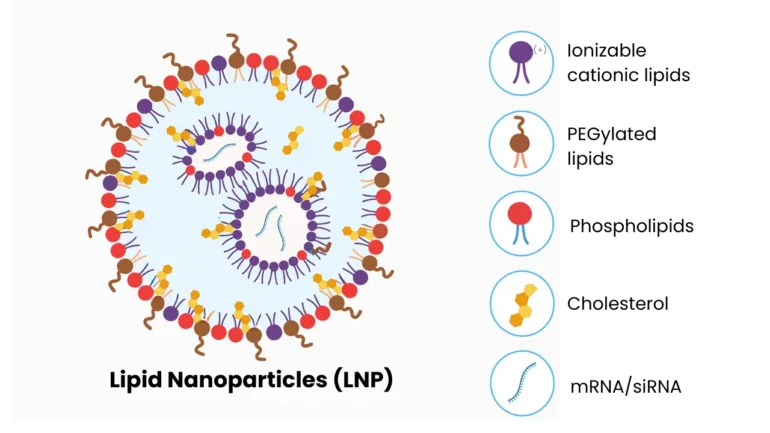
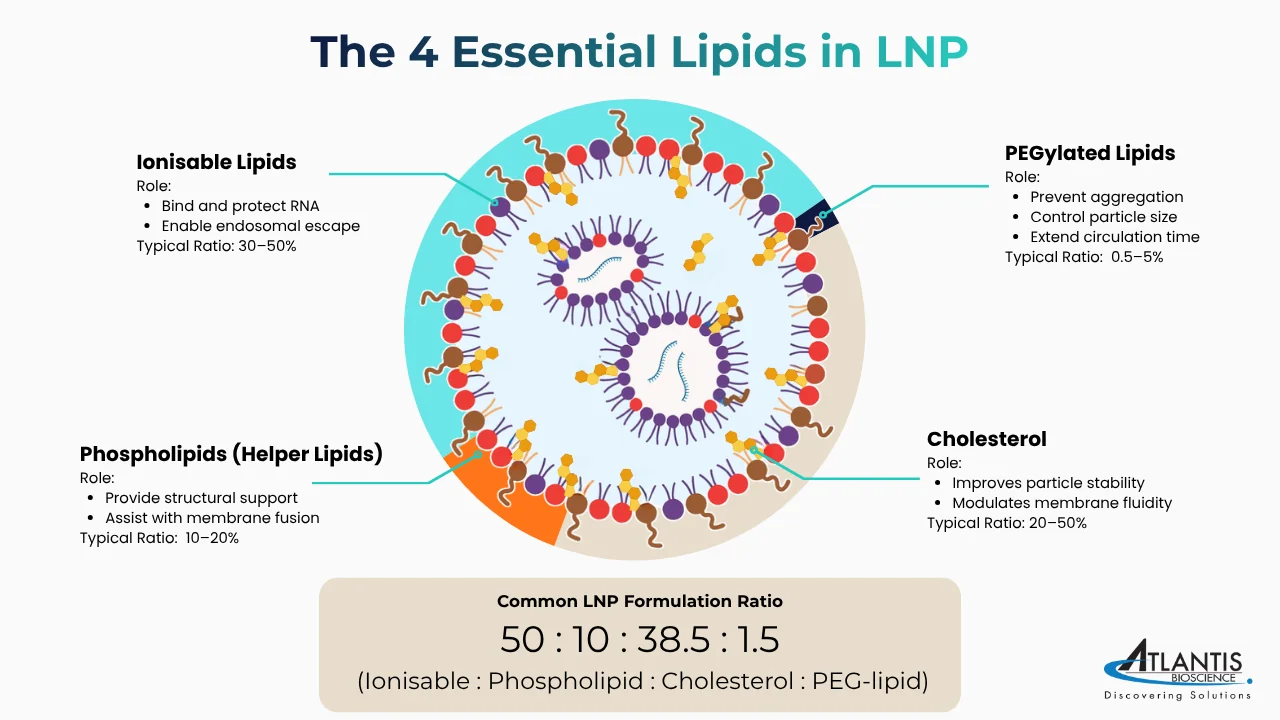
Lipid nanoparticles consist of four key lipids: ionisable cationic lipids for RNA binding and endosomal escape, phospholipids for structural support, cholesterol for stability and membrane fluidity, and PEGylated lipids to prevent aggregation and extend circulation time. Their ratio directly influences RNA encapsulation, delivery efficiency, and safety.
Figure 1: Illustration depicting the 4 essential lipids in lipid nanoparticles (LNPs).
1. Ionizable Cationic Lipids – The Core of RNA Encapsulation
At the heart of every LNP lies the ionizable cationic lipid, often considered the most critical component for successful RNA delivery. These lipids typically carry a positive charge at low pH but become largely neutral at physiological pH. This dual behaviour allows them to securely bind RNA during formulation while minimising toxicity in the bloodstream.
During nanoparticle formation, the ionizable lipid interacts electrostatically with RNA molecules, encapsulating them securely within the LNP. Once the LNP enters a target cell via endocytosis, the acidic environment of the endosome reprotonates the ionizable lipids, destabilising the endosomal membrane and facilitating the release of RNA into the cytoplasm — a process known as endosomal escape.
Examples of widely used ionizable lipids include:
DLin-MC3-DMA – used in the first FDA-approved siRNA drug for hereditary transthyretin amyloidosis (hATTR)
ALC-0315 – a key component of the Pfizer-BioNTech COVID-19 mRNA vaccine (BNT162b2)
SM-102 – used in Moderna’s mRNA vaccine formulations (mRNA-1273)
Beyond these established examples, newer generations of ionizable lipids incorporate biodegradable linkages, enabling faster clearance from the body and reduced long-term toxicity. Because of their pivotal role in both encapsulation and intracellular delivery, ionizable cationic lipids typically make up 30-50% of the total lipid content in most LNP formulations.
In short, without ionizable lipids, the LNP would struggle to protect its RNA payload, efficiently reach target cells, or release its therapeutic cargo — making this lipid truly the core engine of effective RNA delivery.
2. Phospholipids – The Structural Support
While ionizable lipids handle RNA encapsulation and delivery, phospholipids serve as the structural backbone of the LNP. Often referred to as “helper lipids,” they provide the bilayer stability necessary to maintain the particle’s integrity during formulation, storage, and circulation. By mimicking the natural phospholipid composition of cell membranes, these lipids also facilitate membrane fusion, helping the LNP interact with target cells.
The most commonly used phospholipid in LNPs is DSPC (1,2-Distearoyl-sn-glycero-3-phosphocholine). Its saturated acyl chains confer rigidity to the nanoparticle, ensuring the encapsulated RNA remains protected until it reaches the target site. Phospholipids typically account for around 10-20% of the total lipid content in a formulation, a balance that preserves structure without hindering the flexibility required for endosomal escape.
Emerging research is exploring alternative phospholipids with unsaturated or mixed acyl chains to increase membrane fluidity and improve cellular uptake. These subtle variations can enhance delivery efficiency for specific RNA types or target tissues, demonstrating how even a small tweak in lipid chemistry can significantly impact LNP performance.
In essence, phospholipids act as the supporting framework of the nanoparticle, ensuring stability and facilitating interaction with cells, complementing the RNA-binding function of ionizable lipids.
3. Cholesterol – The Stabiliser and Space Filler
Cholesterol may be a familiar molecule from biology class, but in the context of LNPs, it plays a critical role in structural integrity, packing density, and membrane fluidity of the nanostructure. Acting as both a space filler and a membrane modulator, cholesterol fits between other lipid molecules, enhancing packing density and overall structural integrity. This ensures that the LNP remains intact during storage, circulation, and delivery to target cells.
Typically, cholesterol makes up around 20–50% of the total lipid content in a standard formulation. Its presence influences the fluidity and rigidity of the nanoparticle, which can affect both encapsulation efficiency and the release kinetics of RNA inside cells. By adjusting cholesterol content or incorporating cholesterol analogues such as cholesteryl hemisuccinate, formulators can fine-tune LNP performance for specific therapeutic goals.
Cholesterol also contributes indirectly to cellular uptake and endosomal escape. By stabilising the lipid bilayer, it ensures that the ionizable lipids and phospholipids function optimally during endosomal fusion events, allowing efficient release of the RNA payload.
In short, cholesterol acts as the stabilising glue of the LNP, balancing flexibility and durability, and ensuring that the nanoparticle can safely navigate the body while delivering
4. PEGylated Lipids – The Shield for Stability its cargo effectively
The final component in every effective LNP is the PEGylated lipid, often described as the particle’s protective “coat.” By attaching a polyethylene glycol (PEG) chain to a lipid anchor, these molecules create a hydrophilic surface layer that prevents aggregation and minimises recognition by the immune system. This steric stabilisation is crucial for controlling particle size, improving circulation time, and ensuring that the LNP reaches its target tissue intact.
Common PEGylated lipids include DMG-PEG2000, PEG-DMG, and PEG-DSPE, typically making up 0.5–5% of the total lipid mixture. Despite their small proportion, PEG-lipids have a significant impact on the overall performance of the nanoparticle.
One key consideration is the dissociation rate of the PEG-lipid from the LNP surface. If the PEG remains too tightly bound, it can hinder cellular uptake, whereas a faster dissociation rate allows the nanoparticle to interact more readily with cell membranes. This balance is critical in designing LNPs that are both stable in circulation and efficient at delivering their RNA payload.
Emerging research is exploring non-PEG alternatives, such as zwitterionic or polysarcosine-modified lipids, to reduce hypersensitivity reactions observed in some patients while maintaining the protective benefits of PEGylation.
In essence, PEGylated lipids act as the guardian of the nanoparticle, providing stability and biocompatibility while enabling the LNP to perform its delivery function efficiently.
How the Four Lipids Work Together
An LNP is more than just a mixture of individual lipids — it is a carefully engineered system in which each component plays a complementary role. Ionizable lipids bind and protect RNA while enabling endosomal escape. Phospholipids provide structural support and facilitate membrane fusion. Cholesterol stabilises the particle, ensuring durability and proper membrane fluidity. Finally, PEGylated lipids create a protective surface layer, preventing aggregation and extending circulation time.
The precise ratio of these lipids is critical to nanoparticle performance. A commonly used formulation ratio is roughly 50:10:38.5:1.5 (ionizable:phospholipid:cholesterol:PEG-lipid), though slight adjustments may be made depending on the RNA type, target tissue, or desired pharmacokinetics. Even minor changes can influence encapsulation efficiency, particle size, stability, and delivery effectiveness, highlighting the importance of rational design in LNP formulation.
Ultimately, it is the synergy among the four lipids that determines whether an LNP can successfully deliver its RNA payload to target cells — a balance of protection, stability, and release that is fine-tuned for each therapeutic application.
Optimising Lipid Ratios in LNP Design
Optimising lipid ratios is essential for achieving stable, potent, and translatable LNP formulations. Studies show that lipid composition, PEG concentration, particle size, and species-specific requirements must be systematically fine-tuned to refine encapsulation efficiency, stability, biodistribution, and RNA delivery outcomes.
1. Balancing Lipid Components
Some studies maintain a fixed molar ratio across key lipids—PEG-conjugated lipid, ionisable lipid, cholesterol, and DSPC—such as 1.6 : 54.6 : 32.8 : 10.9, while varying other parameters (e.g., particle size, PEG concentration). This ensures consistency in lipid composition during optimisation.
Typical LNP component ranges include:
Ionisable lipid: 30–50%
Cholesterol: 20–50%
Phospholipid (helper lipid): 10–20%
PEG-lipid: 0.5–5%
These ranges are adjusted depending on desired stability, encapsulation efficiency, and delivery performance.
2. Systematic Variation and Screening
Researchers generate multiple formulations with different molar ratios of ionisable lipids, helper lipids, cholesterol, and PEG-lipids, screening each for encapsulation efficiency, particle size, stability, and gene expression or silencing outcomes. This systematic evaluation identifies initial ratio ranges that support effective RNA delivery.
3. Adjusting PEG Concentration
PEG-lipids regulate particle assembly, stability, size, and in vivo shielding. Optimal PEG content varies by species:
Rodents: lower PEG (~1.5–2%) improves potency
NHPs: higher PEG (2.2–2.8%) enhances activity, especially for 50–60 nm particles
PEG must be balanced to avoid excessive shielding that reduces uptake.
4. Controlling Particle Size for Delivery Efficiency
Particle size strongly influences delivery and protein expression.
NHPs: smaller particles (~50–60 nm) are more potent
Particle size is tuned by adjusting lipid ratios or process parameters while keeping total lipid composition constant.
5. Iterative Experimental Optimisation
Researchers frequently conduct iterative DOE studies or ad-hoc experiments to refine lipid compositions further. Examples include increasing cholesterol and helper lipid content while reducing ionisable lipid to improve particle size and encapsulation efficiency. In addition, LNPs can also be engineered or resized to enhance tissue-specific delivery and improve biodistribution.
Overall, the optimization involves an iterative process of formulation, testing, and refinement, leveraging experimental data and rational design principles to tailor lipid ratios for specific therapeutic goals.
Case Studies and Real-World Examples
Understanding LNP design becomes clearer when examining real-world applications, from vaccines to gene-silencing therapies.
Pfizer-BioNTech (BNT162b2) – ALC-0315 The Pfizer-BioNTech COVID-19 vaccine uses ALC-0315 as its ionizable lipid, specifically engineered to encapsulate mRNA and enable endosomal escape while maintaining low toxicity. Combined with helper lipids, cholesterol, and a PEGylated lipid, this formulation creates a stable nanoparticle capable of efficient delivery. Its lipid composition uses a 46.3:42.7:9.4:1.6 ratio of ionizable lipid: cholesterol: helper lipid: PEG-lipid.
Moderna (mRNA-1273) – SM-102 Moderna’s LNPs employ SM-102 as the ionizable lipid, optimised for robust mRNA encapsulation and intracellular release. The lipid components are combined in a 50:10:38.5:1.5 ratio (ionizable lipid: cholesterol: helper lipid: PEG-lipid), ensuring particle stability and controlled delivery.
First FDA-Approved siRNA Therapeutic – Patisiran (Onpattro®) Patisiran, approved in 2018, was the first siRNA therapeutic delivered via LNPs. It treats hATTR by silencing the TTR gene in the liver. Its LNP formulation uses the ionizable lipid DLin-MC3-DMA, together with cholesterol, DSPC, and a PEG-lipid, achieving efficient hepatic delivery. Patisiran exemplifies how LNPs can be adapted beyond vaccines to deliver therapeutic RNA molecules for chronic diseases.
Beyond these examples, ongoing research is exploring next-generation lipids that improve RNA stability, reduce long-term toxicity, or enable tissue-specific targeting. Biodegradable ionizable lipids and ligand-conjugated lipids are emerging as promising strategies for precision RNA therapeutics.
For researchers in Singapore, Thailand, Malaysia, and other Southeast Asia regions working on RNA vaccines, gene therapy, or translational studies, access to reliable formulation support is essential. At Atlantis Bioscience, we support researchers exploring these innovations through PackGene’s LNP formulation services, offering tailored solutions for RNA encapsulation. Combined with our RNA research tools, these services help scientists translate lipid designs from concept to experimental application, accelerating development of safe and effective RNA.
Conclusion
The performance of any LNP hinges on the precise interplay of its four essential lipid components. Ionisable lipids drive RNA encapsulation and endosomal escape; phospholipids support structure; cholesterol stabilises the membrane; and PEGylated lipids protect the nanoparticle in circulation.
Real-world examples—from mRNA vaccines to siRNA therapeutics—demonstrate how deliberate manipulation of lipid ratios enables safe and efficient RNA delivery. With advances in biodegradable ionisable lipids, ligand-targeted lipids, and PEG alternatives, LNP technology is evolving rapidly to support the next generation of RNA medicines.
For researchers and biotech innovators, a deep understanding of these four lipids is essential for designing next-generation LNPs that are safer, more targeted, and optimised for specific applications. With support from PackGene’s LNP formulation capabilities and Atlantis Bioscience’ RNA research reagents, translating these designs from concept to experimental success has never been more achievable.
References
Berger M, Degey M, Curnel A, Evrard B, Piel G. The benefits of emerging alternatives to PEG for lipid nanoparticle RNA delivery systems. Nanomedicine (Lond). 2025 Aug;20(16):1987-1989. doi: 10.1080/17435889.2025.2500917.
Haque, M. A., Shrestha, A., Mikelis, C. M., & Mattheolabakis, G. (2024). Comprehensive analysis of lipid nanoparticle formulation and preparation for RNA delivery. International Journal of Pharmaceutics X, 8, 100283. https://doi.org/10.1016/j.ijpx.2024.100283
Jung HN, Lee SY, Lee S, Youn H, Im HJ. Lipid nanoparticles for delivery of RNA therapeutics: Current status and the role of in vivo imaging. Theranostics. 2022 Oct 24;12(17):7509-7531. doi: 10.7150/thno.77259.
Lam, K., Schreiner, P., Leung, A., Stainton, P., Reid, S., Yaworski, E., Lutwyche, P., & Heyes, J. (2023). Optimizing lipid nanoparticles for delivery in primates. Advanced Materials, 35(26), e2211420. https://doi.org/10.1002/adma.202211420
Xu S, Hu Z, Song F, Xu Y, Han X. Lipid nanoparticles: Composition, formulation, and application. Mol Ther Methods Clin Dev. 2025 Apr 8;33(2):101463. doi: 10.1016/j.omtm.2025.101463.
Zhou, J., Rao, R., Shapiro, M. E., Tania, N., Herron, C., Musante, C. J., & Hughes, J. H. (2025). Model‐Informed Drug Development Applications and Opportunities in mRNA‐LNP therapeutics. Clinical Pharmacology & Therapeutics. https://doi.org/10.1002/cpt.3641
Learn how in vitro transcription (IVT) ensures high-quality mRNA production for vaccines and therapeutics through efficient design and rigorous quality testing.
Discover key criteria for selecting an AAV manufacturing CDMO in Asia. Learn how to ensure quality, scalability, and regulatory expertise for gene therapy success.
HOW CAN WE HELP YOU?Our specialists are to help you find the best product for your application. We will be happy to help you find the right product for the job.