Messenger RNA (mRNA) technology has transformed modern biotechnology, driving breakthroughs in gene therapy, vaccine development, and RNA-based therapeutics. At the heart of this innovation lies in vitro transcription (IVT) — a scalable, cell-free method for synthesizing high-quality mRNA from DNA templates.
Through controlled transcription reactions, IVT enables researchers to design, express, and deliver genetic instructions efficiently, making it an essential platform for both research and clinical applications. However, producing reliable mRNA requires more than transcription alone. Ensuring quality, purity, and consistency across every batch is critical for achieving reproducible biological performance and regulatory compliance.
The IVT Process in Custom mRNA Production
Custom mRNA production using IVT starts with a plasmid DNA template that includes a promoter, gene of interest, and a poly(A) tail. PackGene’s IVT workflowstreamlines mRNA manufacturing — from DNA template to purified transcript — while maintaining scalability and cost-effectiveness across research-grade (RUO) and GMP-grade production.
This workflow ensures:
Consistent template design for reproducible results
Scalable production for preclinical and clinical applications
Efficient transcription chemistry optimised for high yield and purity
Principles of IVT
IVT is a cell-free enzymatic process in which RNA polymerase synthesises RNA from a DNA template. The reaction requires:
A DNA template with a promoter region
RNA polymerase (e.g., T7, T3, SP6)
Ribonucleotides (NTPs: ATP, CTP, GTP, UTP)
Optimised transcription buffer
1. DNA Template Design
The DNA template provides the genetic blueprint for RNA synthesis. It contains the gene of interest and a promoter recognised by the RNA polymerase. During transcription, the enzyme reads the DNA in the 3′ → 5′ direction, producing RNA in the 5′ → 3′ direction.
A well-designed DNA template ensures:
Accurate initiation at the correct site
Proper transcription orientation
High-fidelity RNA synthesis with minimal by-products
2. RNA Polymerase
RNA polymerases catalyse RNA synthesis by adding complementary ribonucleotides sequentially. T7, T3, and SP6 polymerases are commonly used, each recognising a specific promoter sequence.
3. Ribonucleotides (NTPs)
NTPs serve as the building blocks and energy source for RNA synthesis. Their concentration directly affects RNA yield, purity, and transcription efficiency. Balanced NTP levels are critical to producing high-quality mRNA suitable for downstream applications.
4. Transcription Buffer
The transcription buffer creates the optimal environment for RNA polymerase activity. It:
Maintains pH stability
Provides essential ions such as Mg²⁺ and K⁺
Supports proper RNA folding and enzyme function
Fine-tuning the buffer improves both transcription efficiency and the integrity of the resulting RNA.
Structure of IVT mRNA
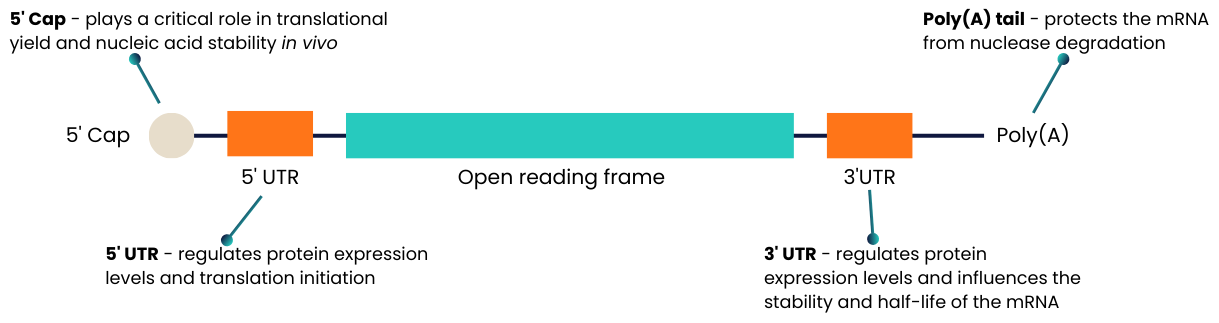
IVT mRNA, also called synthetic mRNA, is a single-stranded RNA molecule engineered to mimic natural mRNA. Its design includes five critical elements that regulate stability, translation efficiency, and protein expression:
5′ Cap The 5′ m⁷G cap protects mRNA from degradation, promotes translation, and modulates immune recognition. Cap structures include:
Cap 0 (m⁷GpppN): Basic cap, supports translation but can trigger immune sensing
Cap 1 (m⁷GpppNm): Adds 2′-O methylation, reduces immunogenicity, enhances translation
Cap 2 (m⁷GpppNmNm): Further methylation improves stability and translational efficiency, though it is less commonly used
Capping can be co-transcriptional (using ARCA or CleanCap®) or post-transcriptional (enzymatic), depending on application needs.
2. 5′ Untranslated Region (5′ UTR)
The 5′ UTR is upstream of the coding sequence and is not translated into protein, but it plays a critical regulatory role. It:
Serves as a ribosome binding site to initiate translation
Influences translation efficiency and mRNA stability
AU-rich sequences in the 5′ UTR can form secondary structures that either enhance or impede ribosome binding
Optimising the 5′ UTR can improve translation and mRNA performance.
3. Open Reading Frame (ORF) The ORF contains the genetic instructions for the protein, beginning with a start codon (AUG) and ending with a stop codon (UAA, UAG, UGA). Codon optimisation can improve translation efficiency, and the CDS may also incorporate modified nucleosides or higher GC content to enhance mRNA stability.
4. 3′ Untranslated Region (3′ UTR) The 3′ UTR follows the stop codon and contains regulatory motifs that control mRNA localisation, stability, and translation. AU-rich elements can trigger degradation, while GC-rich sequences improve stability and translation efficiency. Carefully designing this region helps synthetic mRNAs evade rapid degradation.
5. Poly(A) Tail A stretch of adenosines at the 3′ end protects mRNA from exonuclease degradation and enhances translation. Optimal tail length is typically 100–150 nucleotides, improving stability, translational efficiency, and intracellular persistence.
Figure 1: Key elements in the structure of mRNA
Key Advantages of IVT for mRNA Production
Speed and Scalability – IVT is a fully cell-free process that can be performed rapidly and scaled seamlessly from research to GMP manufacturing, ideal for vaccine development and rapid response during outbreaks.
Safety Profile – IVT mRNA is non-integrating and cytoplasmic, minimising risks associated with DNA- or viral-based systems. The transcript is transient and naturally degrades after a few days.
Flexibility and Adaptability – Changing the DNA template allows rapid production of diverse mRNA sequences for vaccines, therapeutics, or personalised medicine.
Precise Control and Engineering – Researchers can incorporate modified nucleosides to enhance stability, reduce innate immune activation, and improve translation, tailoring mRNA performance for each application.
Simplified Manufacturing – Cell-free production avoids the complexity of cell culture or viral vectors, reduces costs, and simplifies purification and compliance.
Ensuring mRNA Quality with PackGene
Quality control (QC) is essential to guarantee reproducibility, safety, and efficacy. PackGene provides a focused, reliable QC package for every IVT mRNA batch, which includes:
Appearance: Visual inspection for clarity and absence of particulates
Purity: UV absorbance and size-based purity via capillary electrophoresis
Concentration: Accurate quantification of mRNA yield
Endotoxin Level: Gel Clot method to ensure safe thresholds for biological applications
For researchers requiring deeper analytical insights, optional add-on QC is available to assess residual DNA, dsRNA contamination, and host-cell impurities, providing flexibility based on project requirements.
This approach allows Southeast Asian researchers to choose QC depth appropriate to their application, from early-stage proof-of-concept studies to translational-grade mRNA manufacturing.
Accelerate Your mRNA Research with PackGene’s IVT Expertise
PackGene’s IVT service, supported by Atlantis Bioscience, offers a trusted, end-to-end solution for custom mRNA production. Their expertise in RNA synthesis, enzymatic processing, and purification ensures high-quality, transcriptionally active mRNA optimised for stability, purity, and translational performance.
Every standard IVT mRNA order includes core QC checks, delivering reliable and reproducible results, while optional add-on QC allows for greater analytical depth when required. Combined with Atlantis Bioscience’s regional support, this workflow provides Southeast Asian researchers with a complete solution — from design to delivery — enabling innovation to progress efficiently from concept to application.
References
Camperi J, Chatla K, Freund E, Galan C, Lippold S, Guilbaud A. Current Analytical Strategies for mRNA-Based Therapeutics. Molecules. 2025 Apr 6;30(7):1629. doi: 10.3390/molecules30071629.
Kang DD, Li H, Dong Y. Advancements of in vitro transcribed mRNA (IVT mRNA) to enable translation into the clinics. Adv Drug Deliv Rev. 2023 Aug;199:114961. doi: 10.1016/j.addr.2023.114961.
Qin S, Tang X, Chen Y, Chen K, Fan N, Xiao W, Zheng Q, Li G, Teng Y, Wu M, Song X. mRNA-based therapeutics: powerful and versatile tools to combat diseases. Signal Transduct Target Ther. 2022 May 21;7(1):166. doi: 10.1038/s41392-022-01007-w.
Zhang J, Liu Y, Li C, Xiao Q, Zhang D, Chen Y, Rosenecker J, Ding X, Guan S. Recent Advances and Innovations in the Preparation and Purification of In Vitro-Transcribed-mRNA-Based Molecules. Pharmaceutics. 2023 Aug 23;15(9):2182. doi: 10.3390/pharmaceutics15092182.
Discover the top 10 biotechnology trends shaping 2026, from in vivo editing and RNA therapeutics to spatial omics and regenerative medicine innovation.
Learn the four essential lipids in LNP formulation—ionisable lipids, phospholipids, cholesterol and PEG-lipids—and how they drive efficient RNA delivery.
HOW CAN WE HELP YOU?Our specialists are to help you find the best product for your application. We will be happy to help you find the right product for the job.